Portable Power Stations With Solar Panels
Choose a portable power station with solar panel by matching battery capacity to your devices and checking the panel’s voltage, current, connector and polarity against the station’s solar input requirements. Buy a bundle for a complete setup, or a separate panel if you already have a compatible station.
On this page (13 sections)
- How do you choose a portable power station with solar panel?
- How do you match a solar panel to a power station?
- Who should choose the ZOUPW panel?
- Who benefits from Renogy's larger panel?
- Who should choose the lighter FlexSolar panel?
- Should you buy the Jackery station-and-panel bundle?
- How much solar charging can you expect each day?
- How should you set up a portable solar charging system?
- What care helps panels and batteries last?
- Which common mistakes waste solar charging time?
- Is a portable power station with a solar panel safe to use?
- What questions do buyers ask about solar power stations?
- Which portable power station with solar panel should you choose?
A portable power station with a solar panel makes sense when you need stored power after sunset and a way to recharge during daylight. Choose the battery for what you need to run, then choose a compatible panel that can replace the energy you use.
Three options below are panels only; the Jackery option includes both a station and a panel. That difference matters more than panel wattage if you're starting from scratch.
For help comparing battery capacity, output ports and charging methods, see our complete portable power station buying guide.
How do you choose a portable power station with solar panel?
Choose a setup that passes 3 checks: enough stored energy, enough output power and enough daily solar charging. A large panel cannot fix a battery that's too small or an outlet that cannot run your appliance.
Start with the devices you need, their power use and how long they'll run each day. Separate essential loads, such as communication devices and lights, from optional loads you can switch off during poor weather.
Match the power station and solar panel to your daily use
Use watts for power and watt-hours for energy. Watts tell you whether the station can run a device, while watt-hours help you estimate how long it can run.
For example, a device drawing 40W for 5 hours uses 200Wh before conversion losses. Add your other devices to that total, then leave room for losses and a reserve rather than choosing a battery that barely covers the estimate.
Check continuous output as well as any startup surge your appliances need. A station's short surge allowance does not mean it can run a high-draw appliance continuously.
For a weekend trip, you may only need solar to stretch a battery that starts full. For daily off-grid use, the panel needs to replace your daily consumption within the useful sunlight available.
Our guide to choosing a power station size helps turn that device list into a battery and output requirement.
How do you match a solar panel to a power station?
Match voltage, current requirements, connector size and polarity before comparing panel wattage. A plug that fits can still connect equipment with incompatible electrical limits.
Find the station's accepted solar voltage range, current limit and maximum solar input in watts. Check whether separate inputs have separate limits, and follow the manufacturer's rules for the exact port you'll use.
Next, check the panel's operating voltage and open-circuit voltage against those requirements. Open-circuit voltage matters because a panel can produce voltage even when the station isn't drawing power, and cold conditions can raise it.
Do not treat an adapter as an electrical converter. It may change the connector shape without changing voltage or polarity.
A panel rated above the station's wattage limit may be allowed if all other requirements are met and the station manufacturer permits it. A station limited to 60W of solar input, for example, cannot draw the full output of a 100W panel.
Avoid joining panels in series or parallel unless the station and panel instructions support that arrangement. Series connections raise voltage, while parallel connections raise available current, so either can change compatibility.
Who should choose the ZOUPW panel?
Choose the ZOUPW 100W Solar Panel if you already own a compatible station and want several connector options in the box. Its included cable is useful when you want fewer separate adapters to organize.
The included cable is 10 ft long, giving you room to position the panel in sunlight while keeping the battery in a suitable nearby spot. Two adjustable kickstands help support an angled setup.
It weighs about 9.5 lb and folds to 24.13 x 21.06 x 1.77 in. That makes it a better fit for car camping and short carries than for someone trying to minimize every pound.
ZOUPW rates the panel body IP67, but its USB hub and connection cables are not fully waterproof. Protect those parts and the connected station even when the panel surface can handle rain.
Skip it if low carrying weight is your main priority, or if your station needs a different electrical output despite having a matching connector. Choose based on your actual station rather than the number of cable ends.
For more on wall, car and solar charging options, read how to charge a portable power station.
Who benefits from Renogy's larger panel?
Choose the Renogy 200W Solar Panel when your station accepts the input and you want more charging potential during a limited daylight window. It suits a vehicle-based setup where you can leave the panel open for several hours.
Its MC4 solar output needs a suitable connection to your station, and Renogy's 4-in-1 adapter is sold separately. Include that cable check in your buying decision so you don't arrive at camp with parts you cannot connect.
The panel folds to 23.72 x 22.99 x 1.97 in and opens to about 87.8 in across. Measure both the storage space and the clear ground where you expect to deploy it.
The kickstands offer 40°, 50° and 60° positions. Those choices help you aim the panel toward the sun without relying on loose objects to hold it up.
Skip it if your station has a low solar input ceiling and you don't need the extra panel capacity for weaker light. It is also a poor match for campsites where trees or limited ground space prevent you from opening it fully.
Who should choose the lighter FlexSolar panel?
Choose the FlexSolar 100W Solar Panel when carrying weight and packed size matter more than having a larger panel. It is the lightest panel among these options.
It folds to 12.99 x 10.43 x 2.17 in and includes a carry bag. Those dimensions make it easier to fit among other equipment than the broader folded panels here.
Its included cable has DC5521, DC7909, Anderson and XT60 ends. That selection does not include DC8020, so check the exact connection your station requires.
The panel also has 45W USB-C and 18W USB-A outputs for direct device charging. These are useful when you want to charge small electronics without turning on a station's AC inverter, though sunlight still controls the energy available.
Skip it if you need more daily solar input than one panel of this size can provide, or if its included connectors don't cover your setup. A lighter panel is only useful if it can meet your charging needs where you'll use it.
If your main use is a tent or campsite, our portable power station picks for camping can help you choose the battery side of the setup.
Should you buy the Jackery station-and-panel bundle?
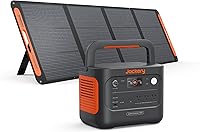
Choose the Jackery Solar Generator 300 if you need both parts and mainly want power for small electronics. It is the only complete station-and-panel bundle among these 4 options.
The station has a 292Wh battery, 300W continuous AC output and a 600W peak surge allowance. Its 2 AC outlets, 100W USB-C port, 2 USB-A ports and 120W car port give you several ways to connect suitable devices.
Jackery uses LiFePO4 battery chemistry and claims more than 4,000 charge cycles before capacity falls to 70%. That cycle claim describes battery aging, not how long one charge will run your equipment.
The included panel favors easy packing over fast replenishment. Jackery quotes about 7.5 hours to reach 80% with that panel, compared with about 2.8 hours using a compatible 100W panel.
Those are sunlight-dependent charging estimates, so don't build a tight travel schedule around them. Start with a full battery and use solar as a daytime refill.
Skip this bundle for electric cooking, space heating or large household backup needs. For those jobs, compare options in our solar generators for home backup guide.
How much solar charging can you expect each day?
Estimate solar energy from average input over useful charging hours, not from the panel's rated watts multiplied by every hour of daylight. Early sun, clouds and shade can leave a large gap between those numbers.
As a planning example, an average 60W reaching the station for 4 hours supplies about 240Wh before storage losses. That is an illustration of the calculation, not an output forecast for any panel here.
Watch the station's input display to learn what your location and setup can supply. A brief high reading is less useful for planning than the power sustained through your charging window.
For a rough recharge estimate, divide the energy you need to replace by the average charging power. Replacing 200Wh at an average 50W takes at least 4 hours, with extra time needed for losses and any slowing near full charge.
If devices are running during charging, some incoming energy serves those loads instead of filling the battery. When device demand exceeds solar input, the battery continues to drain.
Our portable power station runtime guide explains the factors that reduce usable energy when powering devices.
How should you set up a portable solar charging system?
Put the panel in direct sunlight and the station in a dry, ventilated location within its operating limits. The panel needs exposure to the sun; the battery does not need to sit beside it in full sun.
- Choose a clear spot. Avoid shadows from trees, tents, roof edges and nearby gear, including shadows that will move across the panel later.
- Inspect the equipment. Look for damaged cables, dirty connectors, cracked parts or moisture before connecting anything.
- Support the panel securely. Use its supports as directed and keep cables out of walking paths without pulling on the ports.
- Connect in the manual's order. Seat each connector fully, keep unused ends protected and avoid forcing a plug.
- Check charging input. Confirm the station shows incoming power, then adjust panel direction and angle if needed.
- Recheck during the day. Move the panel as shade shifts and bring the setup in when weather exceeds its limits.
If input remains low in clear sun, check for partial shade and loose connections first. Then confirm that the station's solar input settings and the panel's electrical output match its requirements.
Never unplug and reconnect equipment repeatedly to bypass a fault. Stop and follow the troubleshooting steps for the station and panel.
What care helps panels and batteries last?
Keep panel surfaces clean, folds undamaged and electrical connections dry. Dirt, poor storage and strain on cables can make an otherwise suitable setup harder to use.
Remove loose dust gently and clean the panel only as its instructions allow. Avoid abrasive cleaners or rough scrubbing that could damage the surface.
Let damp equipment dry before folding and storing it. Keep grit away from connector openings, and coil cables without sharp bends or pressure on the plugs.
Carry foldable panels by their intended handles or bags rather than by a cable. Don't put heavy gear on top of them or fold sections anywhere other than their designed joints.
Store the station at the charge level and temperature range its manufacturer recommends. Check its charge before a trip or outage season so solar doesn't have to recover an empty battery before you can use it.
Which common mistakes waste solar charging time?
The biggest mistakes are buying the wrong parts, overestimating sunshine and using energy faster than you replace it. Avoid them before spending money on more panel capacity.
- Buying a panel when you need a complete kit. A panel alone does not store energy for night use.
- Choosing by connector alone. Voltage, current and polarity still need to match.
- Treating daylight as full-power charging time. A bright campsite can still have poor panel exposure.
- Ignoring the open footprint. A panel that fits in the trunk may not fit in the sunny gap beside your tent.
- Running optional appliances during a short charging window. Their demand reduces the energy left for later.
- Assuming direct USB charging stores energy. Without a battery in the chain, charging depends on available sunlight.
For an outage plan, reserve battery energy for the devices you cannot easily do without. Solar becomes much more useful when your daily demand is controlled.
Is a portable power station with a solar panel safe to use?
A compatible setup is suitable for use when you follow both manuals and protect it from moisture, damage and excess heat. Weather protection for one part does not extend to every connected part.
Leave the station's ventilation openings clear and keep it on a stable surface. Don't cover it to create shade, put it in a closed hot vehicle or seal it inside a container while operating.
Stop use if you notice swelling, unusual odors, damaged connections, unexpected heat or a fault warning. Follow the manufacturer's shutdown instructions before inspecting the equipment.
Use the station's outlets to power suitable devices directly. Never feed an ordinary household wall outlet from the station; connection to home wiring requires approved equipment and qualified installation.
Read our portable power station safety guide for charging and storage practices.
What questions do buyers ask about solar power stations?
The main questions concern input limits, charging during use and backup coverage. These determine what the setup can do beyond a simple daytime top-up.
Can a solar panel be too powerful for a power station?
Yes, a panel can exceed the station's permitted voltage or other input limits. A higher wattage rating may be allowed, but the station's wattage cap does not protect it from every incompatible electrical connection.
Does a solar panel charge a power station while you use it?
Some stations support this, including the Jackery Explorer 300. Check the manual for operating limits, and compare incoming solar power with device demand to see whether the battery is filling or draining.
Is a portable solar panel enough for a power outage?
It can replenish stored energy during suitable daylight, but you still need enough battery capacity for overnight use and poor weather. Plan around essential devices and keep another charging option available if their operation matters.
Do portable solar panels work in the shade?
They may generate some power, but partial shade can sharply reduce output. Move the whole panel into clear sun rather than assuming an unshaded corner will provide enough energy for a useful recharge.
Which portable power station with solar panel should you choose?
Choose the Jackery bundle if you need both a battery and a panel for small-device use and can allow a long solar charging window. If you already own a station, choose the panel around its input limits and your carrying needs.
Pick ZOUPW for its included cable selection, FlexSolar for the lightest carry here, or Renogy for greater charging potential with a compatible station. Check your daily energy target before choosing a larger panel.
The right portable power station with solar panel covers your essential loads through the night and can recover enough energy during the next charging window. Use our solar charging guide to plan wall, car and solar options before your first trip.
Frequently asked questions
Can I use any solar panel with a portable power station?
No. The panel’s voltage, current and connector polarity must meet the station’s solar input requirements.
Check both manuals and confirm whether you need an adapter. A matching plug does not prove compatibility, and a higher panel wattage cannot override the station’s maximum charging input.
How many watts of solar panel do I need for a portable power station?
Choose panel wattage around your daily energy use, charging window and station’s input limit. A 100W panel can suit small-device top-ups, while a compatible 200W panel offers more charging potential.
Neither delivers its full rated output throughout the day, so allow for clouds, shade and changing sun angles.
Can a solar panel charge a power station on a cloudy day?
Yes, but clouds usually reduce charging power and can make recharge times much longer. Weak light may not provide enough input to start or maintain charging.
Watch the station’s input display, reduce nonessential device use and keep another charging option available when a full battery matters.
Can I leave a portable solar panel outside in the rain?
Only within the panel’s stated weather limits, with its connections and other equipment protected as their manuals require. A waterproof panel body does not make the power station, controller or cable ends waterproof.
Bring the equipment in before severe weather and avoid connecting or disconnecting wet electrical parts.