7 Best Portable Power Station for a Refrigerator (October 2026)
The best portable power stations for refrigerator backup include the Jackery Explorer 1000 v2 for shared household use, the EcoFlow Delta 3 Classic for demanding fridge starts, and the Bluetti AC180 for brief recharge windows.
On this page (11 sections)
- How we chose the best portable power station for refrigerator backup
- Which refrigerator power station fits your household?
- How much power does your refrigerator actually need?
- What battery capacity covers your target outage?
- Why do standby draw and extra loads matter?
- Should you leave the refrigerator connected through a UPS feature?
- How should you set up refrigerator backup before an outage?
- Can solar panels keep the refrigerator running through a longer outage?
- Which habits preserve backup time and battery readiness?
- What mistakes should refrigerator backup buyers avoid?
- Which is the best portable power station for your refrigerator?
The Jackery Explorer 1000 v2 is the best portable power station for refrigerator backup if you want a movable option for shorter outages and your fridge fits its output limits. For longer coverage, start with the roughly 2kWh models below.
Choose the battery around your refrigerator's energy use, not its size or door style. A station can have enough power to start the compressor yet run out of stored energy before your outage ends.
Start with how many watts a refrigerator uses to separate running demand from daily consumption. Then decide how long you need backup and how you'll recharge.
Our complete portable power station buying guide explains the main terms. The guide to running a refrigerator from a power station goes deeper into appliance compatibility.
Our picks at a glance
-
1

-
2

-
3

How we chose the best portable power station for refrigerator backup
Startup compatibility, useful battery capacity and a workable recharge plan matter most for refrigerator backup. We compared those needs alongside weight, standby consumption, placement and automatic backup features.
The order favors a movable starting option, followed by models that solve more specific problems. A lower-ranked station may suit your home better if you need expansion, more stored energy or a permanent kitchen setup.
Output tells you which loads a station can support; capacity helps determine how long it can support them. Neither a large surge figure nor a fast transfer time replaces an energy-use calculation.
| Product | Best for | Capacity | AC output | Weight | Our score |
|---|---|---|---|---|---|
| Jackery Explorer 1000 v2 | shared household use | 1,070Wh | 1,500W; 3,000W surge peak | 23.8 lb | 9.2 |
| EcoFlow Delta 3 Classic | demanding fridge starts | 1,024Wh | 1,800W; 3,600W surge | 26.7 lb | 8.9 |
| Bluetti AC180 | brief recharge windows | 1,152Wh | 1,800W; 2,700W boost mode | 37.4 lb | 8.5 |
| EcoFlow Delta 3 Max | multiple essential loads | 2,048Wh | 2,400W rated; 3,400W X-Boost | 8.4 | |
| Anker SOLIX C2000 Gen 2 | expandable outage coverage | 2,048Wh | 2,400W rated; 4,000W peak | 41.7 lb | 8.3 |
| Jackery Explorer 2000 v2 | room-to-room backup | 2,042Wh | 2,200W | 39.5 lb | 8.1 |
| Bluetti FridgePower | permanent kitchen placement | 2,016Wh | 1,800W; 3,600W surge | 7.1 |
Which refrigerator power station fits your household?
Choose by outage length and how the station will be used between outages. The smaller picks suit easier movement and shorter coverage, while the larger batteries give you more energy to work with.
1. Jackery Explorer 1000 v2: best portable power station for refrigerator backup you can move
Jackery Explorer 1000 v2: Best for shared household use
- 1,070Wh capacity
- 1,500W AC output
- 3,000W surge peak
- LFP battery
A movable choice for shorter refrigerator outages that can also serve other rooms between emergencies. Its foldable handle and three pure sine wave AC ports suit shared household use.
Pros
- 23.8 lb with foldable handle
- Three pure sine wave AC ports
- Default full charge in 1.7 hours
Cons
- Less stored energy than the roughly 2kWh picks
- One-hour emergency charging requires app activation each time
Choose the Jackery Explorer 1000 v2 if you want to move one station between the refrigerator, a home office and occasional trips. Its 23.8 lb weight and foldable handle make that more practical than with the heavier models here.
The battery holds 1,070Wh, with 1,500W AC output and a 3,000W surge peak. Match the compressor's startup requirements to that capability before making it your outage plan.
Three pure sine wave AC ports leave room for other devices, but reserve most of the battery for refrigeration during an outage. An unused outlet is not unused energy waiting to be spent.
Jackery gives a default full-charge time of 1.7 hours. Its claimed one-hour emergency charge requires app activation before each use, so learn that step before bad weather arrives.
Skip it if your energy calculation calls for substantially more stored power between recharges. Solar panels are separate, and this model requires Jackery panels for solar charging.
2. EcoFlow Delta 3 Classic: for refrigerators with demanding starts
EcoFlow Delta 3 Classic: Best for demanding fridge starts
- 1,024Wh capacity
- 1,800W output
- 3,600W surge
- Under 10ms UPS
More output headroom than the top pick without moving to a roughly 2kWh battery. Choose it when compressor startup is the main hurdle and shorter backup coverage fits your plan.
Pros
- Higher rated and surge output than the top pick
- Under 10ms UPS transfer
- EcoFlow claims 0–80% AC charging in 45 minutes
Cons
- Higher output does not add battery capacity
- Not compatible with DELTA 2 Smart Extra Battery or DELTA 3 Series Smart Extra Battery
Choose the EcoFlow Delta 3 Classic when your main hurdle is compressor startup rather than a long outage. Its 1,800W output and 3,600W surge rating offer more headroom than the top pick.
The 1,024Wh battery is in the same capacity class as the smaller Jackery. Moving up in output here does not mean moving up in stored energy.
EcoFlow specifies under 10ms UPS transfer and claims AC charging from 0 to 80% in 45 minutes. That combination suits a planned backup connection with quick replenishment when grid power returns.
At 26.7 lb, it is also a more manageable moving option than several larger picks. Check the required surge duration, since a peak watt figure alone cannot confirm a successful compressor start.
Skip it if your plan depends on adding a DELTA 2 Smart Extra Battery or DELTA 3 Series Smart Extra Battery. Neither is compatible, so size this purchase around the capacity it actually provides.
3. Bluetti AC180: for short chances to recharge
Bluetti AC180: Best for brief recharge windows
- 1,152Wh capacity
- 1,800W output
- 2,700W boost mode
- 20ms backup switching
A useful option when power returns briefly between outages. Bluetti claims a full recharge in one hour at 1,440W AC input, and AC, car and solar charging cables are included.
Pros
- More capacity than the first two picks
- AC, car and solar charging cables included
- Bluetti provides a five-year warranty
Cons
- Heavy for its battery capacity
- Boost mode should not be treated as a confirmed compressor surge rating
Choose the Bluetti AC180 if grid power returns in brief windows and you want to refill the battery quickly. Bluetti claims a full charge in one hour at 1,440W AC input.
Its 1,152Wh battery gives a modest energy increase over the first two picks. The 1,800W rated output is the starting point for checking appliance loads; the app-enabled 2,700W boost mode should not replace a compressor compatibility check.
The AC180 includes AC, car and solar charging cables. That gives you useful connection options, though each source still has its own input limits and charging speed.
Its main compromise is carrying weight: at 37.4 lb, the extra battery capacity comes with a sizable increase over the smaller models. Bluetti provides a five-year warranty.
Buy it for frequent top-ups and mostly stationary use. Skip it if carrying the station up stairs or moving it daily matters more than recharge speed and the modest capacity gain.
4. EcoFlow Delta 3 Max: for a fridge plus selected essentials
EcoFlow Delta 3 Max: Best for multiple essential loads

- 2,048Wh capacity
- 2,400W rated output
- 3,400W X-Boost
- Under 10ms transfer
Its larger battery and rated output suit a refrigerator plus selected household essentials. Set an energy allowance for those extra devices so they do not consume your refrigerator reserve.
Pros
- Roughly twice the capacity of the smaller picks
- Under 10ms transfer time
- EcoFlow claims 0–80% charging in about 1.13 hours
Cons
- 19.44-inch height needs space
- X-Boost is separate from the rated output
Choose the EcoFlow Delta 3 Max if your outage plan includes a refrigerator and a small allowance for other essentials. Its 2,048Wh battery and 2,400W rated output give you more room to plan both energy and simultaneous loads.
EcoFlow specifies under 10ms transfer and claims charging from 0 to 80% in about 1.13 hours. That helps when you need to restore a large portion of the battery before another interruption.
Keep its 3,400W X-Boost mode separate from normal output and compressor surge compatibility. Build the refrigerator plan around supported operating conditions.
Measure your intended space before ordering: the unit is 19.44 inches tall. Leave room to reach controls and plugs as well as the ventilation clearance in its instructions.
Skip it if you only need brief coverage and would rather move a smaller unit. If you choose it for several devices, give each one an energy allowance before assuming the larger battery will cover everything.
5. Anker SOLIX C2000 Gen 2: for an expandable outage plan
Anker SOLIX C2000 Gen 2: Best for expandable outage coverage

- 2,048Wh capacity
- 2,400W rated output
- 4,000W peak
- 9W standby use
A larger starting battery with an expansion path to 4kWh. Its specified standby consumption also helps you account for energy used while the refrigerator compressor is off.
Pros
- Expandable to 4kWh
- Specified 9W standby consumption
- Anker claims a full charge in 58 minutes using AC and solar together
Cons
- 41.7 lb before adding an expansion battery
- Expansion battery adds another item to place and move
Choose the Anker SOLIX C2000 Gen 2 if you want a larger battery now and an expansion path later. It starts with 2,048Wh and can expand to 4kWh with an added battery.
Anker specifies 9W standby consumption and claims up to 32 hours powering a dual-door refrigerator. Use your own refrigerator's consumption to plan coverage, since the door layout does not establish its energy demand.
Its 2,400W rated output and 4,000W peak provide room for compatible loads. Keep high-draw kitchen appliances off the backup circuit when preserving refrigerator runtime is the priority.
Anker claims a full recharge in 58 minutes using AC and solar together. That is a combined-source charging figure, so it should not become your assumption for every charging method.
At 41.7 lb, this is better suited to planned placement than frequent carrying. Skip it if expansion has little value to you and a smaller battery already covers your expected outage.
6. Jackery Explorer 2000 v2: for moving a larger battery between rooms
Jackery Explorer 2000 v2: Best for room-to-room backup
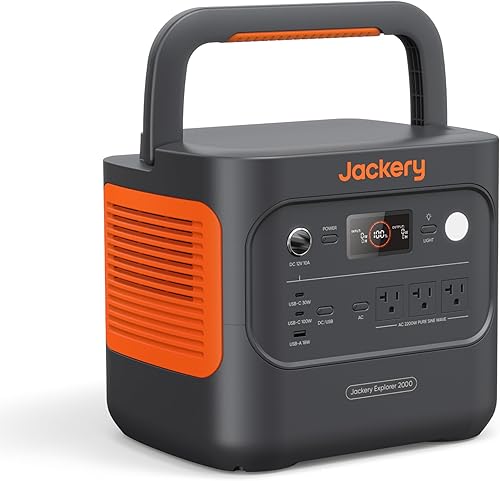
- 2,042Wh capacity
- 2,200W AC output
- 39.5 lb
- 20ms switching
A roughly 2kWh option for households that move backup power between storage and an appliance. It weighs less than the Anker C2000 Gen 2 and Bluetti FridgePower.
Pros
- Larger battery without a fixed installation
- Three AC ports and 100W USB-C
- Jackery offers a slower silent charging mode
Cons
- Still a substantial load to carry
- Full emergency charging requires the app
Choose the Jackery Explorer 2000 v2 if you want roughly 2kWh of stored energy in a unit you can relocate. Its 39.5 lb weight is lower than the Anker C2000 Gen 2 and Bluetti FridgePower, though it still calls for a careful carry.
The battery holds 2,042Wh, and its three AC ports share 2,200W of output. Confirm startup compatibility before assigning the refrigerator and another appliance to those outlets.
Jackery claims AC charging from 0 to 80% in 66 minutes. Full emergency charging takes 102 minutes through the app, while its slower silent charging mode offers another option when time is less pressing.
Solar charging uses a DC8020 connection. Plan the panel and cable setup before relying on sunlight during an outage.
Skip it if you need expansion as part of your buying decision or want a wall-mounted kitchen setup. Its appeal is a larger self-contained battery that can move with the household's needs.
7. Bluetti FridgePower: for a dedicated kitchen position
Bluetti FridgePower: Best for permanent kitchen placement

- 2,016Wh capacity
- 1,800W output
- 4W standby use
- 10ms UPS
A slim refrigerator-focused design with freestanding and wall-mount options. Its low specified standby use and expansion support suit a backup system that stays near the appliance.
Pros
- Specified 4W standby consumption
- Freestanding or wall-mounted placement
- Expandable to 8,064Wh with BlueCell 200 batteries
Cons
- 41.9 lb despite the slim shape
- Lower rated output than the other roughly 2kWh picks
Choose Bluetti FridgePower if the station will stay near the refrigerator and a thin shape solves a real placement problem. Its 75mm profile supports freestanding or wall-mounted use.
The 2,016Wh battery pairs with 1,800W output and a 3,600W surge rating. Bluetti specifies 4W standby consumption, which matters when the compressor spends part of each hour switched off.
It offers 10ms battery switching and four UPS modes: Standard, PV Priority, Time of Use and Customized. Choose a mode that preserves the charge you need for outages.
Expansion to 8,064Wh with BlueCell 200 batteries gives this model a path to more stored energy. Add those batteries to your space plan rather than judging the whole system by the slim main unit.
Skip it for frequent trips or room changes: it weighs 41.9 lb. Wall mounting also needs suitable support, and a narrow gap is usable only if both appliances retain their required clearance.
How much power does your refrigerator actually need?
Check startup demand for compatibility and daily energy use for runtime. Those are different measurements, and both belong on your shopping checklist.
The compressor draws power while running and may need a brief higher input to start. Defrost heaters, fans and other refrigerator functions can also change demand during the day.
Find the refrigerator's model number, manual and electrical label. Voltage multiplied by amperage gives a rough electrical comparison, but it does not reveal daily consumption or prove startup requirements.
A plug-in energy meter can help measure consumption over complete days of normal use. Choose one suitable for the appliance, and record conditions such as room warmth and frequent door openings.
Use the refrigerator wattage guide to work through the numbers. If the refrigerator is only part of your plan, compare power stations for home backup before choosing capacity.
What battery capacity covers your target outage?
Size the battery from average consumption, backup hours and an energy reserve. A station's nameplate capacity is not the amount of AC energy your refrigerator will receive.
First convert daily consumption into average watts. A refrigerator using 1.8kWh per day uses 1,800Wh daily, which works out to an average of 75W.
That average includes cycling across the measurement period. It is useful for energy planning, but the station must still support the higher load when the compressor runs.
For an 8-hour outage, that example needs about 600Wh delivered to the refrigerator. For 16 hours, it needs about 1,200Wh before accounting for station losses and a reserve.
A simple planning formula is:
Required nominal capacity = average watts × backup hours ÷ usable-energy allowance.
For illustration, allowing 80% of nominal capacity for the refrigerator turns the 8-hour example into 750Wh. That allowance is a planning assumption, not a measured efficiency for any station here.
Leave additional room for an older battery, a warm kitchen or a delay in recharging. Buying exactly enough for a favorable day leaves little flexibility when conditions change.
Do not add standby consumption twice if your usable-energy allowance already includes it. For a detailed calculation, separate inverter losses, station overhead and your chosen remaining-charge reserve.
Why do standby draw and extra loads matter?
Every device drawing from the station reduces the energy left for the refrigerator. Station overhead also continues while the compressor is off if the AC inverter remains active.
A constant 10W draw uses 240Wh over a full day. That is why a small difference in standby consumption can matter during a long outage.
Compare standby figures only when their operating conditions match. A consumption number from one mode may not describe every setting or connected load.
Make a short priority list before connecting extras. A phone may deserve a small energy allowance, while a kettle or other heating appliance can consume the refrigerator reserve much faster.
If you want to compare a smaller station with a larger one, our guide to what size portable power station you need helps build a combined load plan.
Should you leave the refrigerator connected through a UPS feature?
Use automatic backup only in a setup supported by both equipment manuals. A transfer-time figure describes switching speed, but does not confirm every aspect of refrigerator compatibility.
Check the permitted continuous load, charging arrangement and behavior after the battery runs low. Also find out whether AC output returns automatically after charging or needs manual action.
Review any energy-saving or automatic shutoff setting. A refrigerator's quiet period between compressor cycles should not cause the station to stop supplying the outlet.
Before relying on automatic backup, confirm the refrigerator resumes normal operation during the manufacturer's recommended setup check. If you need to reconnect it, follow the refrigerator's restart instructions rather than cycling power repeatedly.
Keep the battery charged to the level your outage plan requires. A system used for scheduled daily discharge may have less energy available when an unexpected outage begins.
How should you set up refrigerator backup before an outage?
Prepare a dry, ventilated operating spot and a clear connection route before you need them. Avoid placing the station where refrigerator heat, a water leak or blocked vents could cause trouble.
- Measure the space. Include plug depth, cable bends, control access and the clearances required by both manuals.
- Check the outlet and circuit. Fast AC charging adds a substantial load, so account for other appliances sharing the circuit.
- Plan a direct connection. If an extension cord is necessary, use a properly grounded cord suitable for the load and follow both manufacturers' instructions.
- Confirm the settings. Learn how to enable AC output, select the intended backup mode and read the remaining charge.
- Write down the routine. Keep the charging cable and brief setup notes where another household member can find them.
Do not connect a portable station to a household wall outlet to feed home wiring. Powering installed circuits requires equipment and installation intended for that purpose.
For further placement and electrical guidance, read are portable power stations safe.
Can solar panels keep the refrigerator running through a longer outage?
Solar can replace some of the energy used during daylight, but it needs a realistic daily energy budget. Panel wattage alone does not tell you how much energy will reach the battery.
Clouds, shade, panel angle and short winter days can reduce charging. Plan enough battery coverage for darkness and decide what happens if the next day brings little useful sun.
Match panel voltage, current and connectors to the station's limits. Cold conditions can raise panel open-circuit voltage, so leave the margin required by the equipment instructions.
The Bluetti AC180 accepts compatible third-party panels within its 12 to 60V open-circuit range and 500W total solar input limit. A connector that fits does not establish electrical compatibility.
Keep the station sheltered as its instructions require while positioning panels for sunlight. Route cables where doors, feet and vehicle tires cannot damage them.
Our portable power stations with solar panels guide explains how to build the charging side. For grid and other supported charging methods, see how to charge a portable power station.
Which habits preserve backup time and battery readiness?
Reduce avoidable refrigerator demand and keep the station ready between outages. Simple preparation is more useful than trying to stretch an almost-empty battery after power fails.
Keep refrigerator door openings brief and leave its ventilation clear. Avoid putting a large amount of warm food inside just as the outage begins.
Use a refrigerator thermometer to track conditions inside the appliance. A battery display shows electrical status, not food temperature.
Follow FoodSafety.gov's outage guidance when deciding what food to keep. Do not use remaining battery percentage as evidence that food stayed safe.
For station care, follow the manual's storage charge, temperature and inspection guidance. Recheck the charge before storm season, and keep vents free of dust without opening the enclosure.
What mistakes should refrigerator backup buyers avoid?
Avoid buying by peak watts or promised runtime alone. The most common planning errors come from mixing power, energy and charging claims.
- Treating boost output as compressor surge support. Confirm the supported load type and surge duration.
- Using running watts as a constant daily average. Measure complete cycles, including normal defrost behavior.
- Assuming a larger inverter means longer coverage. More output does not add stored energy.
- Planning around the fastest recharge headline. Check the required mode, input source and circuit capacity.
- Expecting expansion batteries to be interchangeable. Confirm the exact supported battery and cable.
- Ignoring the carry route. A manageable floor-level move may become difficult on stairs.
Also plan for the outage that outlasts the battery. Decide where the next charge can come from and when you will change your food-storage plan.
Which is the best portable power station for your refrigerator?
The best portable power station for refrigerator backup is the one that can start your compressor and cover the gap until your next dependable charge. Choose output first, then buy enough usable energy for that gap.
Pick the Jackery Explorer 1000 v2 for shorter coverage and easier movement. Choose the EcoFlow Delta 3 Classic when extra startup headroom matters, or the Bluetti AC180 when brief recharge windows shape your plan.
For more stored energy, choose the EcoFlow Delta 3 Max for selected shared loads, the Anker SOLIX C2000 Gen 2 for expansion, or the Jackery Explorer 2000 v2 for a larger movable battery.
Choose Bluetti FridgePower when permanent kitchen placement is the priority. Before ordering, write down your fridge's startup requirement, daily consumption, target backup hours and next charging source.
If you also need to support other rooms, compare the best portable power stations for power outages using that same load plan.
Our top 3 picks at a glance
-
1
-
2
-
3
Frequently asked questions
What size power station do I need to run a refrigerator?
Choose output for the refrigerator's running and startup needs, then choose battery capacity for your target backup hours. A roughly 1kWh station can suit shorter coverage, while a roughly 2kWh model stores about twice as much energy.
Use measured daily consumption and allow for conversion losses, standby use and a reserve.
How long can a portable power station run a refrigerator?
Runtime depends on average refrigerator demand and the energy available after losses. For illustration, 850Wh of usable energy divided by a 75W average load gives about 11 hours.
That calculation assumes the usable-energy allowance already covers station overhead; warmer rooms, frequent door openings and extra devices can shorten coverage.
Can a power station handle refrigerator startup?
Yes, if its inverter supports the compressor's startup demand for the required duration. Check continuous output, surge capability and appliance compatibility rather than relying on a large boost number.
If startup requirements are missing from the refrigerator manual, ask the appliance manufacturer before choosing a station.
Is a refrigerator-specific power station better?
A refrigerator-focused station makes sense when it will stay beside the appliance and its shape, standby consumption or backup controls solve a placement problem. A general-purpose model suits households that move power between rooms or trips.
Both still need enough output for startup and enough stored energy for the outage.


